
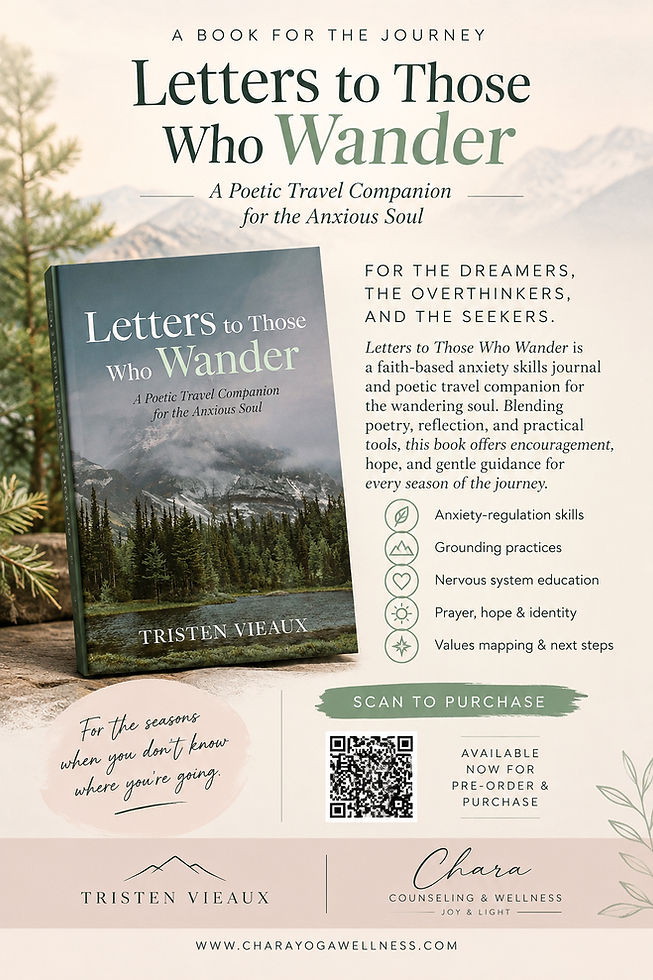
A poetic travel companion for the anxious soul
When writing I experience space for breath, a holding of what is unknown, felt and a creation of quiet introspection.
I am often asked the following that I wanted to share with you.💗
1. What inspired you to write
Letters to Those Who Wander?
What if feeling lost is not failure—but the beginning of finding your way home? I wrote Letters to Those Who Wander for anyone who feels overwhelmed, anxious, uncertain, or unsure what comes next. As a therapist, I’ve seen how quietly people carry anxiety while trying to keep moving forward. I wanted to create a compassionate companion—not a textbook—a place to pause, breathe, reflect, pray, and remember that you don’t have to have everything figured out to keep going.
2. What makes Letters to Those Who Wander
different from a traditional poetry or self-help book?
The book blends poetry, reflection, faith, and practical mental health support. Alongside poetic letters are journal activities, anxiety-management skills, prayers, reflection prompts, and gentle practices that invite readers to participate, not just read. It’s designed to be revisited in different seasons, offering what each reader needs in the moment.
3. Who is this book written for?
It’s for the anxious soul, the overthinker, the person navigating transition, and anyone asking, “Where do I go from here?” You don’t need a diagnosis or a crisis to connect with these pages. This book is for anyone learning to slow down, listen inward, reconnect with faith, and find steadiness in uncertainty.
4. How does your work as a psychotherapist influence the book?
My clinical work has taught me that healing is rarely linear. We carry stories in our thoughts, bodies, relationships, and nervous systems—and reconnecting with ourselves often requires more than words. My training in psychotherapy, EMDR, IFS, somatic approaches, mindfulness, and yoga therapy shaped the book’s practical tools, making them approachable, compassionate, and useful in everyday life.
5. What do you hope readers take away from
Letters to Those Who Wander?
I hope readers feel less alone and begin to see that wandering is not the same as failing or falling behind. Sometimes wandering is part of becoming. These pages offer peace for the anxious mind, space to explore what matters, a reminder of God’s presence, and practical tools for taking the next small step.
I hope this book brings a unique blessing and gift to anyone who holds these pages.
Love and blessings,
Tristen


Comments